How Long Does A Fully Charged E-Bike Battery Last? Battery Life On A Guided E-Bike Tour
No Melbourne tour operator publishes a battery range, but the tour figures, the legal 250 W assist cut-off and a pre-booking checklist tell you whether a full day on an e-bike is realistic.
Battery anxiety is the most common reason people hesitate before booking an e-bike tour. The worry is reasonable: if the motor dies halfway round, a pedal-assist bike becomes an ordinary, slightly heavy bicycle, and nobody wants to discover that at the top of a hill. No Melbourne tour operator publishes a battery range, a charge time or a motor spec sheet for the bikes it uses. That gap is not a cover-up, it is simply how the industry lists its products, and it means the answer has to be assembled from what you can verify: the legal limits on the bikes themselves, the published distance and duration of the tours, and the questions to put to an operator directly.
No Melbourne e-bike tour operator publishes a battery range, charging time or capacity, so no single figure exists, but the practical answer is reassuring: the Melbourne E-Bike Tour With Local Guide covers about 16 km including stops over roughly 4 hours on legal 250 W pedal-assist bikes whose assist cuts off at 25 km/h, and a fully charged battery is comfortably sufficient for a ride of that shape.
The reason the direct answer does not exist on paper is that tour fleets change, and booking pages describe the experience rather than the hardware. What the booking pages do publish is distance and duration, and those two figures answer the real question behind the battery question, which is "will I finish the ride?" For the city e-bike tour, about 16 km including stops and a lunch break in about 4 hours is the published shape of the day. No operator in this city publishes a battery range, so never accept a number quoted in a forum or a review as official: treat it as one rider's anecdote.
The physics also help. A legal e-bike in Victoria assists only while you pedal and stops assisting at 25 km/h, which means the motor works in short bursts at takeoffs and on climbs rather than pulling continuously. Riders on guided city tours spend much of the day coasting between landmarks, listening to commentary and walking around stops. That duty cycle is gentle on a battery compared with a commuter sprinting a full charge out in an hour.
The Melbourne E-Bike Tour With Local Guide from Blue Tongue Bikes is the city's main guided e-bike product: about 16 km, about 4 hours including a lunch stop, a 10am start on the booking page, groups up to 10, and a pedal-assist e-bike, helmet and lock supplied with the guide. It is rated 4.9 from 300+ reviews, costs from A$139 per person, and asks only that you can ride a bike, since the electric assistance makes the ride manageable even if you do not ride often. If battery doubt is what has been holding you back from an e-bike day in Melbourne, that tour is the natural first look, and readers planning a full-day decision can compare it against the wider e-bike and pedal-bike formats below.
What Are The Legal Limits On A Tour E-Bike's Motor?
In Victoria, a legal EPAC is capped at a motor of 250 W of continuous rated power and works only while you pedal, with assistance cutting off at 25 km/h; a throttle is allowed only up to 6 km/h as a walk mode. These caps shape battery life, since such a modest motor draws charge slowly rather than running flat out. Confirm with your operator which legal category its tour bikes fall into.
The law defines the bike, and the bike defines the drain. Transport Victoria's e-bike rules page sets out the two legal types: the EPAC described above, marked to EN15194 with working pedals, and a second type, the Power-Assisted Pedal Cycle, with a peak power output of 200 W or less. Anything tampered beyond those limits, or with no pedals at all, may only be ridden on private property, and fines apply on public roads and paths. Tour operators ride on public roads and shared paths all day, so their fleets must fit within these legal categories; confirm the specific spec with the operator before you book.
The 25 km/h cut-off deserves a plain explanation, because it shapes expectations. It is the assist that stops at 25 km/h, not the bike: you can pedal past that speed under your own power, exactly as on any bicycle. On flat city ground most guided riding happens around or below the cut-off anyway, with the motor topping up your effort rather than replacing it. Hills are where the assist earns its keep, and where the battery does its real work.
| Legal feature (Transport Victoria) | What it means on tour | Effect on the battery |
|---|---|---|
| Motor at most 250 W continuous rated power | Modest motor, marked EN15194 | Lower sustained draw than high-power machines |
| Assist only while pedalling | No twisting a throttle to zoom off | Charge spent in proportion to your own effort |
| Assist cuts off at 25 km/h | Above that speed you are pedalling unassisted | Motor rests whenever you ride fast or descend |
| Throttle only to 6 km/h walk mode | Throttle is for walking the bike, not riding | Throttle riding is not part of any tour |
| Working pedals required | It is a bicycle first, motor second | A flat battery still leaves a rideable bike |
Two practical corollaries follow. First, never expect a tour e-bike to be fast, and treat any description of one as fast as a red flag rather than a selling point. Second, a legal e-bike with a flat battery is still a functioning bicycle, so worst case on a guided ride is a heavier pedal home in the company of a guide, not a stranding.
If the idea of a motor working this politely suits you, the question shifts from battery to booking format, and free cancellation up to 24 hours before applies on the booking page of every tour listed here.
Does Pedal Assist Drain The Battery Faster Than You Think?
No, guided-tour pedal assist drains slower than most riders fear, because assist is proportional and intermittent: the motor adds a share of the effort only while your feet are turning, rests above 25 km/h, and idles entirely during the long stopped portions of a tour. Riding mode matters more than ride length, and a full day of stop-start sightseeing can use less charge than a short, hard commute.
The biggest variable is not the kilometres, it is how hard you ask the motor to work. Most pedal-assist systems offer several assistance levels, and a rider on the lowest setting does much of the work personally. Riders who can already ride a bike comfortably, which is the only stated requirement of the city e-bike tour, tend to settle into a low-assist rhythm quickly. Weight plays its part too: the tour lists riders up to 113 kg and about 150 cm or taller, and a heavier rider or a strong headwind asks more of the motor on the same hill.
Terrain and stops reshape the arithmetic in a visitor's favour. The published city route rolls along the Yarra, past the Shrine, the MCG, Cooks' Cottage, Parliament, Fitzroy, the Royal Exhibition Building, Chinatown and Hosier Lane, which is a day of short hops between photo stops rather than a point-to-point grind. Time spent at a laneway wall or over lunch is time the battery is doing nothing at all. If you are weighing regular pedals against a motor generally, the comparison in choosing between an e-bike or a regular bike for a guided ride works through the same trade-off from the comfort side.
One caveat stays in place: battery capacity, charge time and whether the motor recovers any charge while pedalling are not published for any tour e-bike, and none of those should be guessed at from other brands or other cities. Ask the operator, and treat the answer you get by email as the only real specification.
What Should You Ask The Operator Before Booking?
Ask four things: what battery capacity the fleet carries and what typical range the guide sees on this exact route, whether spare batteries or a support plan travel with the group, what assistance level the tour rides at by default, and what happens to the ride if a battery runs flat. Operators answer these by email without hesitation, and the replies are the only real specification you will ever get.
A short checklist turns an unknown into a booking decision. None of these questions is unreasonable, and none of them is answered on a booking page, which is exactly why they are worth sending.
| Question to send | Why it matters | A good answer sounds like |
|---|---|---|
| What is the battery capacity of the fleet, in watt-hours? | The only real range figure, straight from the operator | A number, with the typical range the guide observes |
| Does the guide carry a spare battery or a follow plan? | Determines the worst case mid-ride | No operator publishes this, so ask before booking |
| What assistance level does the group ride on? | Sets how much of the work the motor does | A named mode, with an offer to adjust it per rider |
| Has a battery ever run flat on this route? | Reveals the real margin on the published distance | A straight yes with the story, or a confident no |
| Is the bike swapped if a fault appears? | Shows how mechanical issues are handled | Swap on the spot, tour continues |
For the private formats the same questions carry extra weight, because the route is arranged with you rather than fixed. The Private Melbourne E-Bike Tour, from A$500 per person with the price depending on group size as shown on the booking page, runs 2 to 4 hours with a dedicated guide, a minimum age of 12, and the operator arranging the route and start point with the group. On a private ride you can shape the day to the battery rather than the reverse: shorter, flatter, or split with a long lunch.
The Famous Melbourne City Cycling Tour With Local Guide takes a different route to the same reassurance: it is a pedal tour at heart, rated 4.9 from 900+ reviews over 4.5 hours from A$140 per person, with an optional e-bike upgrade at A$40 per person. Because the upgrade bolts onto a tour designed for ordinary bikes, the route was never dependent on motor range in the first place.
Is A Full-Day E-Bike Ride Realistic?
Yes, on the right tour, and the durations support it: the city e-bike tour runs about 4 hours over about 16 km, the private format stretches to 4 hours with a custom route, and the separate Yarra Valley e-bike alternative runs a 7-hour day on a fat-tyre e-bike.
The published details point the same way. The Yarra Valley Guided And E-Bike Rail Trail Cycling listing covers two products: a 6-hour guided ride from A$350 per person on standard bikes with bike and helmet included, minimum age 18, groups up to 8, coffee, tea, snacks and lunch, a 10am start at Woori Yallock Station and free pickup from Lilydale railway station; and a separate 7-hour fat-tyre e-bike rail trail alternative, from A$395 per person, for groups up to 10, not suitable for riders under 155 cm or over 130 kg. Confirm the e-bike spec with the operator before booking. Our longer treatment of planning a Yarra Valley rail trail ride by e-bike covers that day in detail.
For the bayside option, the Mornington Peninsula Small-Group Bike Tour from Bayplay Adventure Tours uses single-rider e-bikes for riders over 14, runs 2.5 hours from A$120 per person from the Point Nepean Information Centre, in groups up to 15. Shorter days and coastal flat make battery questions almost theoretical there.
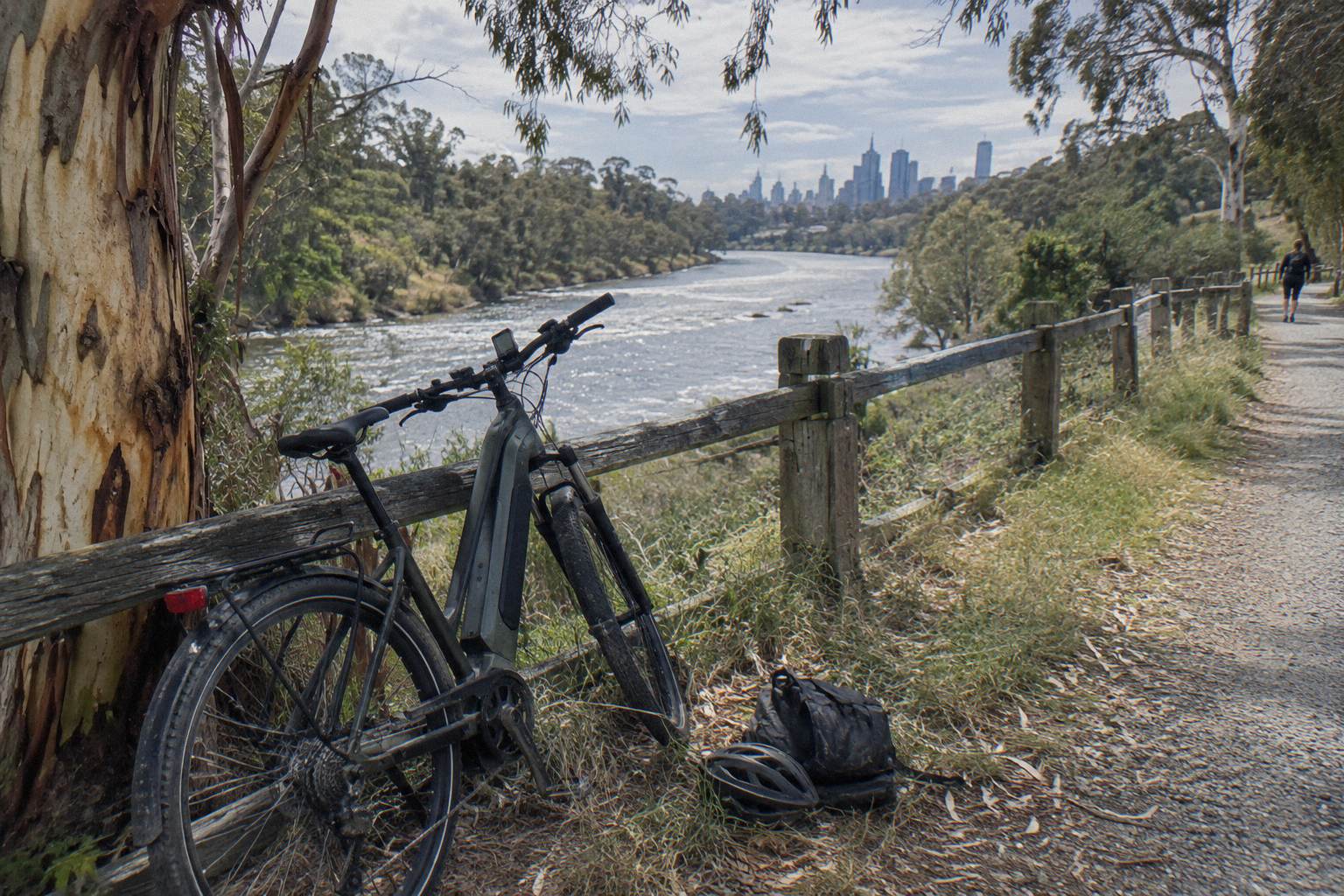
If your day is your own rather than guided, the same logic applies with less support: plan distance first, battery second. The round-the-city option, the Capital City Trail, is the classic self-guided loop and is covered in riding the Capital City Trail loop. Melbourne's climate cooperates more than its reputation suggests: averages from the Bureau of Meteorology put the mean maximum at 25.9 °C in January and 13.5 °C in July, with about 650 mm of rain spread across every month, roughly 100 rain days a year. Mild days ask less of both rider and battery.
What If The Battery Does Run Flat Mid-Ride?
On a guided tour the realistic worst case is mild: the bike becomes an ordinary bicycle with some extra weight, and the guide manages the situation. Riders are never alone with the problem, which is the core argument for guided e-bike riding over solo hire when battery doubt is the worry.
Guides carry the responsibility for the fleet, and mechanical issues of every kind, flat tyres included, are part of the job. The questions in the checklist above, asked before booking, tell you exactly how each operator handles a mid-ride failure, and any operator reluctant to answer that one is telling you something useful. Note also that the city e-bike tour's stated requirement is only that you can ride a bike, because the electric assistance makes the ride manageable even if you do not ride often; the fitness baseline is low by design.
Melbourne's rules remove a few stresses that catch visitors elsewhere. Helmets are mandatory for everyone, e-bike riders included, and they are normally supplied on tour, so there is nothing to carry from home. Shared paths run keep-left with riders giving way to pedestrians, which keeps tour speeds social. And since assist stops at 25 km/h anyway, nobody on a legal e-bike is tempted into the traffic-speed riding that makes a mechanical failure genuinely dangerous.
Getting to the start is also simpler than in some cities, with one sharp edge: under Transport Victoria's rules for bicycles on public transport, metro trains carry bikes and factory-built e-bikes switched off, but trams and buses take folding bikes only, so ride to a station rather than a tram stop. The details are in how bikes and e-bikes travel on Melbourne public transport's companion coverage of city cycling logistics, and the broader question of whether Melbourne is a good city for cycling has its own answer page.
Which E-Bike Tour Format Suits A Rider Who Worries About Range?
Choose by exposure, not by battery spec: the 4-hour shared city tour suits a first-time e-bike rider who wants the shortest leap of faith; the private format suits a rider who wants the route matched to their confidence; the 6-hour Yarra Valley guided ride runs on standard bikes with helmet included, while its 7-hour e-bike alternative suits a rider who has already decided a full day sounds good. Range doubt shrinks as the format gets more supported, not as any published number grows.
Because no operator publishes a battery range, the decision logic has to run on structure. A shared tour with a fixed published route and a group of up to 10 is the most predictable product on the board. A private tour hands you control of the distance and the terrain before you ever clip a helmet. A supported long day in the valley is the format whose very existence demonstrates that full-day e-biking works in this region.
Three related questions come up again and again: how hard electric bikes are to ride, how fast electric bikes ride within the law, and whether you must pedal all the time on an electric bike. The short version of all three favours the cautious rider: assist is gentle, capped and optional, and Melbourne Bike Tours lists every e-bike format the city offers so you can compare without hunting.
Before booking anywhere, run the checklist, confirm the cancellation terms, which are free up to 24 hours before on every tour's booking page here, and send the operator the capacity question. The reply is the only battery specification that will ever be real, and the operators answer it.

Which Mistakes Feed Battery Anxiety On A Day Ride?
The main one is trusting a number nobody publishes. No Melbourne operator prints battery range, capacity or charge time, so the only real specification is the operator's email reply. After that: worrying about a flat battery stranding you, when a guided ride leaves you with a heavier bicycle and a guide, and forgetting that assist rests above 25 km/h and idles at every stop.
- Treating a forum range as fact. Battery figures quoted in reviews or by other brands are anecdotes, not specifications for the bike you will ride.
- Assuming the throttle drains the pack. A throttle works only to 6 km/h in walk mode; the motor assists only while you pedal.
- Forgetting the stops. A day of short hops, photo pauses and lunch means long stretches where the battery does nothing at all.
- Skipping the pre-booking questions. Ask about fleet capacity, observed range, spare batteries and what happens if a cell runs flat; hesitant answers tell you something.
- Planning a tram escape. If doubt makes you want to fold the day early, trams take folding bikes only, and metro trains carry e-bikes switched off, so plan a station route instead.
Common Questions About E-Bike Battery Life
How Long Does A Fully Charged E-Bike Battery Last? Battery Life On A Guided E-Bike Tour
No Melbourne operator publishes a battery range or charge time. The verifiable anchors are the legal 250 W motor with a 25 km/h assist cut-off and the published shape of the city tour, about 16 km including stops in about 4 hours. Ask the operator for the fleet's capacity and observed range, and treat any other number as anecdote.
Can An E-Bike Battery Run Out On A Guided Tour?
It is possible but rarely consequential on a guided ride: the bike becomes an ordinary, somewhat heavier bicycle, and the guide manages the situation. Asking before booking how a flat battery is handled tells you the operator's plan.
Do You Have To Pedal The Whole Time On An E-Bike Tour?
Yes, the motor assists only while you pedal, and the throttle works only to 6 km/h in walk mode. Assist also cuts off at 25 km/h, though you can pedal faster under your own power. The system adds effort rather than replacing it.
Is A Full-Day E-Bike Ride Realistic Near Melbourne?
Yes. A separate Yarra Valley product runs a 7-hour day on fat-tyre e-bikes, in groups of up to 10, from A$395 per person, not suitable for riders under 155 cm or over 130 kg.
Does Pedalling Recharge An E-Bike Battery?
That is not published for any tour e-bike in Melbourne, and no claim either way should be assumed. Ask the operator directly if it matters to you, and rely on the published tour distances and durations for planning instead.
Do I Need To Be Fit To Finish An E-Bike Tour?
The city e-bike tour asks only that you can ride a bike, since the electric assistance makes the ride manageable even if you do not ride often. It lists riders about 150 cm or taller and up to 113 kg, and anyone under 18 rides with an adult.